Hoi An has its own distinct food culture that does not exist anywhere else in Vietnam. This guide covers the essential dishes, where to find them, and how to eat well without fighting the crowds.
Hoi An is about 30 minutes south of Da Nang by car, and it is a natural half-day or full-day stop for any traveller based in Da Nang. Most visitors come for the Ancient Town: the lanterns, the yellow walls, the tailors. But Hoi An also has one of the most distinctive local food cultures in all of Vietnam.
Several dishes here exist only in Hoi An. You cannot find the authentic version in Ho Chi Minh City or Hanoi. That alone makes the town worth visiting with an appetite.
Cao Lau: The Dish That Defines Hoi An
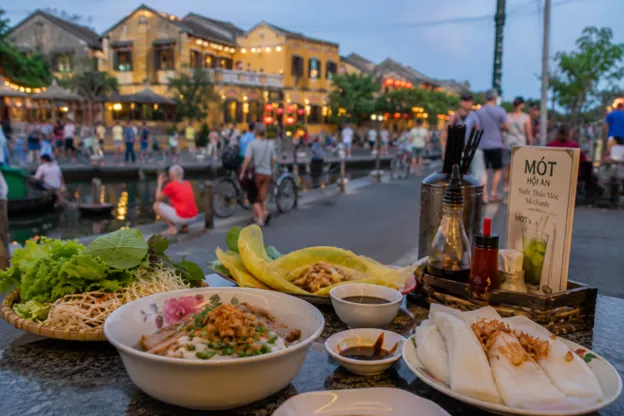
Cao lau is the one dish that is specific to Hoi An and cannot be properly replicated elsewhere. The thick, chewy noodles are made using ash water drawn from particular wells in the region, traditionally water from the Cham wells outside town. The noodles are served with sliced char siu-style pork, crispy rice crackers, bean sprouts, fresh herbs, and a small amount of rich broth.
The texture is unlike any other noodle dish in Vietnam. The broth is minimal, barely enough to coat the noodles, so the dish eats more like a dry noodle than a soup. If you eat nothing else in Hoi An, eat this.
Find it at Trung Bac restaurant on Tran Phu Street, or at the stalls inside Hoi An Central Market where local women have been serving it for decades. A bowl costs around 40,000 to 60,000 VND.
White Rose Dumplings (Banh Bao Vac)
White rose dumplings are translucent steamed dumplings filled with seasoned prawn, shaped into delicate folded parcels that resemble a rose. They are served with a crispy shallot topping and a light dipping sauce. The texture is soft and slightly sticky from the rice flour wrapper.
Like cao lau, this dish is closely associated with Hoi An and is made almost exclusively by one family who supplies most of the restaurants in town. You will find it at the White Rose Restaurant on Hai Ba Trung Street, which is the original source, or at most local eateries in the Ancient Town that serve traditional dishes. Expect to pay around 60,000 to 80,000 VND for a plate of six to eight pieces.
Banh Mi Phuong
Banh mi in Hoi An has a specific reputation. Banh Mi Phuong on Phan Chau Trinh Street has been the best-known banh mi stall in town for years and was put on the global map by Anthony Bourdain’s visit in 2009. The bread is freshly baked, the fillings are generous, and the assembly is fast.
Expect a queue. The stall operates from early morning until the bread runs out, which on busy days can be before noon. Come before 9am for the best experience. The pork liver pate and char siu combination is the one to order. A banh mi here costs around 35,000 to 50,000 VND.
There are other good banh mi stalls in Hoi An, and the competition from Phuong’s fame has sharpened the whole town. If the queue at Phuong’s is overwhelming, Banh Mi Phuong 2 (a short walk away) or the stalls near the Central Market are reliable alternatives.
Com Ga Hoi An: Hoi An Chicken Rice
Com ga is chicken rice, a dish Singapore visitors know well. But Hoi An’s version is distinct. The rice is cooked in chicken broth and turmeric, giving it a light yellow colour and a fragrant, slightly earthy flavour. Toppings include shredded poached chicken, fresh herbs, fried shallots, and pickled vegetables.
Compared to Hainanese chicken rice, it is lighter, more herb-forward, and served at room temperature rather than piping hot. Com Ga Ba Buoi on Phan Chu Trinh Street is the most-cited spot by locals. Lunch-only, closed when the rice runs out. Arrive before noon.
Mi Quang: Turmeric Noodles
Mi Quang is the noodle dish of Quang Nam province, of which Hoi An is part. It uses flat turmeric-yellow noodles, a small amount of thick broth, and toppings that vary but typically include pork, prawn, quail egg, peanuts, and a large sesame rice cracker. The broth is rich but minimal; again, this is more of a dry noodle than a soup.
It is available across Da Nang and Hoi An, but the versions in Hoi An tend to be more traditional. Look for Mi Quang stalls in the market area or ask your guide to take you to a local spot away from the tourist strip.
Che Ba Le and Fresh Coconut
For dessert, Che Ba Le on Le Loi Street is the most-visited spot in Hoi An for Vietnamese sweet soups. The che here comes in multiple varieties (pandan jelly, green bean, lotus seed, black sesame) and is served in small cups with shaved ice and coconut milk. Order two or three types to try.
After eating, fresh coconut is sold throughout the Ancient Town and at the Central Market. A whole coconut with a straw costs around 20,000 to 25,000 VND and is the most practical way to cool down between sites.
Where to Eat: Beyond the Ancient Town
The Ancient Town has the most visible food scene but also the highest tourist premium. For lower prices and a more local atmosphere, the Cam Nam area across the bridge from the Ancient Town has several small restaurants where Hoi An residents actually eat. The walk takes about ten minutes from the main drag.
Hoi An Central Market, on the riverfront, is the other essential eating destination. The upper floor has a row of stalls serving cao lau, white rose, and com ga at fixed low prices. It is busier in the morning. The ground floor has produce, fresh herbs, and the raw ingredients that make Hoi An cooking distinct.
Practical Tips
Go before 7pm to avoid the peak crowd in the Ancient Town, particularly on weekends when the lantern festival atmosphere draws large numbers. Many stalls run out of food (especially cao lau and com ga) before evening. A food-focused visit works best as a morning or early afternoon activity.
Most stalls are cash-only. Bring Vietnamese dong in small denominations. ATMs are available near the Ancient Town entrance.
Hoi An’s best food is affordable even by Vietnamese standards. A full meal of cao lau, a plate of white rose dumplings, and a cup of che should come to under 150,000 VND per person, roughly SGD 8.
Plan Your Trip
Browse our private Vietnam tour packages from Singapore, priced in SGD with no hidden fees. Private guide, 3 to 4 star hotels, and meals included from SGD 448 per person.
Related Reads
- Hoi An Ancient Town In-Depth
- 4 Days in Da Nang: Itinerary for Singapore Families
- Da Nang vs Hoi An for Singapore Families
- Ba Na Hills: Tickets, Cable Car and Full Guide