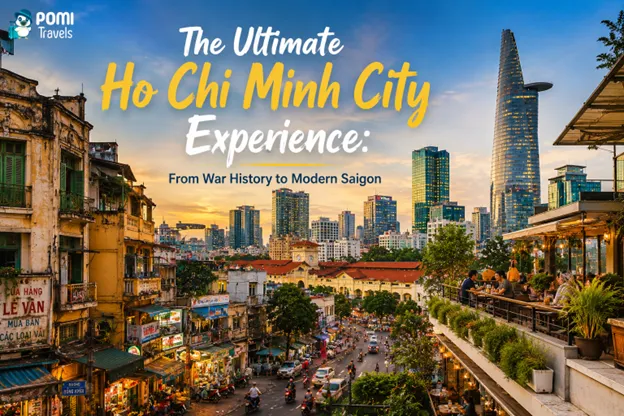
Ho Chi Minh City gives you war history, French colonial landmarks, markets and modern energy in one compact trip. This guide shows Singapore travellers how to experience the full range.
Ho Chi Minh City works because it does not ask you to choose one version of Vietnam.
You can spend the morning in a war museum, the afternoon inside French colonial landmarks, and the evening in a market or rooftop bar. For Singapore travellers, it is one of the easiest short breaks in the region because the direct flight takes about 2 hours.
If you want one city that shows history, speed, commerce and everyday life at once, this is it.
Start With District 1
Most first-time visitors should base themselves in District 1.
That keeps you close to the core landmarks and makes short trips more efficient. The site content also places many package hotels here, along with strong access to halal-certified restaurants around Ben Thanh Market and the central district area.
From District 1, you can build the city in layers.
Layer One: War History
Start with the sites that define modern Vietnam’s historical memory.
The two anchors are:
Reunification Palace gives you preserved interiors, command rooms and a clear physical link to the end of the war. War Remnants Museum is more confronting. Go in with time and attention rather than trying to squeeze it between shopping stops.
Then add Cu Chi Tunnels as a half-day or full-day extension if you want the wider wartime context beyond the city itself.
Layer Two: Colonial Saigon
Once you understand the political history, move into the older urban core.
The cleanest architectural pair is:
- Notre-Dame Cathedral
- Central Post Office
These are central, easy to visit, and useful for understanding how Saigon developed as a colonial city. They also work well in the same walking route as Reunification Palace, which keeps transport simple on a short trip.
Layer Three: The Market City
Ho Chi Minh City is not only about monuments.
To understand the city properly, spend time in places where trade still drives the street rhythm. Ben Thanh Market remains the easiest entry point. Go in the morning if you want the market at its most functional, not just souvenir-focused.
Then, if you want a deeper commercial and cultural contrast, head to Cholon Chinatown and Binh Tay Market. This shows you a denser, more Chinese-influenced side of the city that feels very different from the polished central district.
Layer Four: Spiritual Saigon
Many travellers miss this layer because they over-focus on war history.
The Jade Emperor Pagoda changes the tone of the trip. Incense, carvings and ritual atmosphere give you something less formal and more lived-in than the civic landmarks. It is one of the best stops if you want the city to feel less like a checklist.
Layer Five: Greater Ho Chi Minh City
The city also works as a base for excursions.
The strongest add-ons from the site’s tour content are:
Each gives you a different extension. Cu Chi adds history. Mekong Delta adds river life and sampan travel. Ba Den Mountain adds a cable car, pilgrimage context and open views.
Best Structure for a Short Trip
If you have 3D2N, keep it focused:
- Day 1: District 1 landmarks
- Day 2: Cu Chi or Mekong Delta
- Day 3: market time and departure
If you have 4D3N or 5D4N, you can do more:
- one full city day
- one war-history day
- one excursion day
- one flexible half-day for Chinatown, pagoda visits or food
That is where the city starts to feel complete.
Food and Halal Practicality
This city is one of the easier Vietnam destinations for Muslim travellers from Singapore.
The site confirms halal-certified restaurants are available, especially in District 1 and around Ben Thanh Market. That makes hotel choice important. Stay central and the city becomes much easier to navigate meal by meal.
Best Time to Go
Ho Chi Minh City works best from December to April, which is the dry season and the site’s preferred travel window. February to April gives the cleanest conditions for city walking and day trips.
You can still visit in the wetter months, but build around the expectation of rain rather than hoping to avoid it.
What Makes the Experience Feel Complete
A complete Ho Chi Minh City trip is not just about seeing the famous places.
It means combining:
- one historical site
- one colonial landmark zone
- one market experience
- one neighbourhood with local texture
- one trip outside the city if time allows
When travellers skip one of those layers, the city can feel one-dimensional.
Related Reads
- To choose the right base, read Ho Chi Minh City Districts Explained: Where Singapore Travellers Should Stay and Explore.
- For one of the city’s core history stops, see Independence Palace: Understanding Vietnam’s Colonial and Modern History.
- Before visiting the city’s toughest museum, read War Remnants Museum: Navigating Vietnam’s Complex War History as a Singapore Visitor.
- For the main war-history day trip, use Cu Chi Tunnels: Understanding Vietnam War History and the Underground Network.
Final Take
The ultimate Ho Chi Minh City experience is not luxury, nightlife or history alone.
It is the combination of Reunification Palace, War Remnants Museum, Notre-Dame Cathedral, Central Post Office, Ben Thanh Market, Cholon, and at least one strong side trip like Cu Chi, Mekong Delta or Ba Den Mountain.
Build the trip from the centre, stay in District 1, and let each day show you a different version of Saigon. That is when the city starts to make sense.
Plan Your Trip
Browse our private Vietnam tour packages from Singapore, priced in SGD with no hidden fees. Private guide, 3 to 4 star hotels, and meals included from SGD 448 per person.
View Ho Chi Minh City Tour Packages
Back to all articles