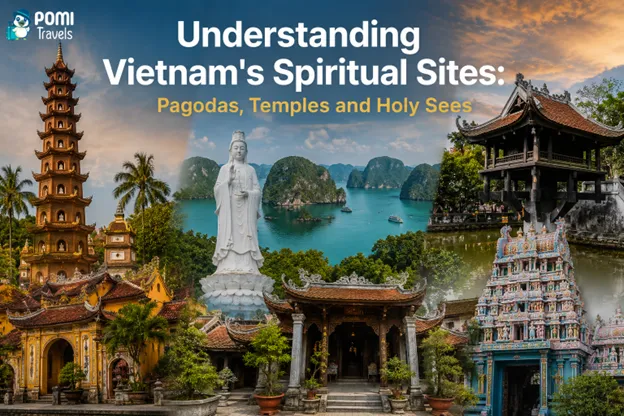
Vietnam's spiritual sites can look similar at first glance, but they serve different traditions and purposes. This guide helps Singapore travellers visit them with more context and less confusion.
Vietnam’s spiritual sites are not all the same.
Travellers often use “temple” as a catch-all term, then arrive and realise each place has a different role, atmosphere and etiquette. If you understand the basics before you go, the visits become much more meaningful.
This matters because spiritual sites appear across Vietnam itineraries, from Linh Ung Pagoda in Da Nang to the Jade Emperor Pagoda in Ho Chi Minh City and the holy site at Tay Ninh linked with Ba Den Mountain day trips.
Pagoda, Temple or Holy See?
Start with simple working definitions.
A pagoda in Vietnam usually refers to a Buddhist religious site. You will often see statues of the Buddha, incense areas, bells, courtyards and a calmer devotional layout.
A temple can refer to a site dedicated to a deity, historical figure, ancestor tradition or Chinese-influenced worship system. In practice, travellers may still hear locals or guides use overlapping English terms.
A holy see refers to the central religious complex of a faith. In Vietnam, the best-known example for travellers is tied to Cao Dai practice in Tay Ninh.
What You Will See in Different Cities
Vietnam’s spiritual geography changes by region.
In Da Nang, one of the clearest examples is Linh Ung Pagoda on Son Tra Peninsula. The site content highlights the 67-metre Lady Buddha statue and the wide bay views. This is a scenic religious site, but it is still an active place of worship.
In Ho Chi Minh City, the Jade Emperor Pagoda presents a very different atmosphere. The site describes it as a Taoist temple built by the Cantonese community, dense with incense, carvings and ceremonial figures. It feels darker, older and more inward-looking than a coastal pagoda viewpoint.
Near Ho Chi Minh City, Ba Den Mountain and Black Lady Temple add another dimension. This is where spiritual pilgrimage and scenic excursion overlap.
What Makes Vietnamese Spiritual Sites Distinct
The strongest feature is layering.
You may see Buddhist imagery, Chinese decorative forms, local devotional practices, ancestor offerings and regional customs all in one journey. The sites do not always feel minimalist or quiet in the way some visitors expect. They can be smoky, colourful, crowded and full of symbolic detail.
That does not make them confusing. It means you should observe before you photograph.
Basic Visiting Etiquette
You do not need to memorise a long rulebook.
Use these basics:
- dress modestly
- speak softly
- remove hats in prayer spaces when appropriate
- do not block worshippers
- ask before photographing monks, nuns or active prayer
- treat incense and offering areas with respect
If you are visiting with children, explain before entering that this is not just a sightseeing stop.
How to Read the Atmosphere
When you enter a spiritual site, pay attention to how people use the space.
Are they praying for health, family and exams? Are they making offerings? Are they moving through the space slowly or gathering in larger devotional groups? That tells you more than any plaque.
At places like Linh Ung, part of the appeal is the setting and viewpoint. At places like Jade Emperor Pagoda, the spiritual atmosphere is the main experience.
Common Types of Traveller Stops
For most Singapore travellers, spiritual sites fall into three trip patterns:
| Type of stop | Example | What to expect |
|---|---|---|
| Scenic pagoda stop | Linh Ung Pagoda, Da Nang | Easy visit, views, open grounds |
| Urban devotional site | Jade Emperor Pagoda, Ho Chi Minh City | Dense interior, incense, strong atmosphere |
| Pilgrimage-linked excursion | Black Lady Temple, Tay Ninh | Religious context tied to a wider day trip |
This helps you plan expectations. Not every site needs the same amount of time.
When These Sites Fit Best in an Itinerary
Spiritual sites work well as part of a broader day, not always as the whole day.
In Da Nang, Linh Ung often pairs naturally with Son Tra Peninsula. In Ho Chi Minh City, Jade Emperor Pagoda can slot into a city sightseeing route. In Tay Ninh, the holy and mountain components connect to a longer excursion.
That is why these places show up so often in package itineraries. They add cultural depth without needing a separate specialist trip.
Plan Your Trip
Browse our private Vietnam tour packages from Singapore, priced in SGD with no hidden fees. Private guide, 3 to 4 star hotels, and meals included from SGD 448 per person.
Related Reads
- For the Cao Dai side of this topic, read Cao Dai Holy See in Tay Ninh: A Unique Spiritual Experience.
- For a Tay Ninh pairing, see Ba Den Mountain: World’s Largest Cable Car Station and the Roof of the South.
- For a Chinese temple example in Saigon, read Thien Hau Temple in Cholon: Saigon’s Most Revered Chinese Temple.
- For one large pagoda stop in the north, use Ninh Binh for Nature Lovers: Trang An, Hoa Lu and Bai Dinh Pagoda.
Why Context Matters
Without context, travellers often remember only the visuals.
With context, you start noticing why one place feels airy and another feels smoky, why some sites face outward to the landscape and others turn inward around altars, and why local visitors behave differently in each one.
That understanding makes the visit more respectful and more memorable.
Final Take
Vietnam’s pagodas, temples and holy sees should not blur together in your itinerary.
Treat each site as its own religious and cultural space. Learn the basic category, watch how locals use it, and keep your visit measured. Once you do that, even a short stop becomes much richer than a quick photo and walk out.
Back to all articles