
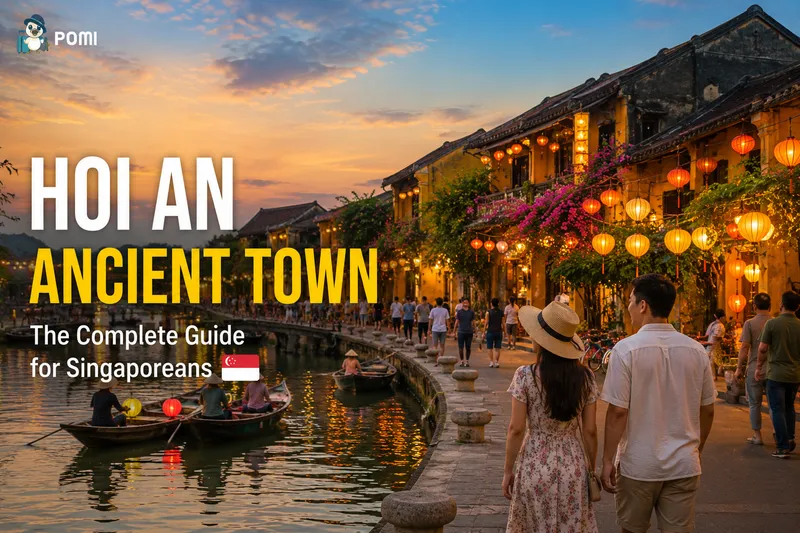
Hoi An Ancient Town is one of the best-preserved trading ports in Southeast Asia. Here is everything Singapore travellers need to know before visiting.
Hoi An Ancient Town is not a theme park recreation. It is a working town where families still live in shophouses that are three and four centuries old. UNESCO gave it World Heritage status in 1999 because the streets, facades, and layout of the trading port have survived almost intact.
For Singapore travellers, it sits comfortably within a Da Nang trip. The drive from Da Nang takes about 30 minutes by car, and most people visit as either a day trip or by basing themselves in Hoi An for two or three nights.
What Makes Hoi An Different
Most old towns in Southeast Asia have been partially demolished and rebuilt. Hoi An is unusual because the merchants and colonial administrators who passed through (Vietnamese, Chinese, Japanese, and French) each left architectural traces that were never torn down.
You see this clearly on Tran Phu Street, the main heritage street. The Japanese Covered Bridge at one end is 400 years old. A few doors down, Fujian-style assembly halls stand next to French colonial shop fronts next to Vietnamese tube houses. The mix is not decorative. It is the actual historical record of who traded here.
Key Sites to Visit
Japanese Covered Bridge is the most photographed structure in Hoi An. It was built by Japanese merchants in the early 1600s and has been restored several times since. Go in the early morning before tour groups arrive for the clearest photos.
Tan Ky Old House is a privately owned merchant home that has been in the same family for eight generations. The interior shows how goods, furniture, and decorative styles from Japan, China, and Vietnam mixed in a single household.
Fujian Assembly Hall (Phuc Kien) is the most impressive of the assembly halls in town. Built by the Fujian Chinese community, it has elaborate roof decorations and a courtyard that is particularly photogenic in the late afternoon light.
Quan Cong Temple is a working temple dedicated to a Chinese general revered across southern China and Vietnam. It is active, so be respectful when entering and dress conservatively.
The Ticket System
Hoi An charges a heritage ticket to enter the Ancient Town’s ticketed sites. As of recent visits, one ticket covers entry to five sites chosen from a fixed list across different categories. You buy the ticket at any of the official booths around the Ancient Town entrance.
Not every building in the Ancient Town requires a ticket. You can walk the streets freely. Tickets are checked only when you enter specific heritage buildings. If you plan to visit more than five sites, you will need to buy additional tickets.
Carry cash in Vietnamese Dong. Some ticket booths do not accept cards.
Best Time of Day
Arrive before 8:30am if possible. The Ancient Town becomes crowded by mid-morning as tour groups arrive from Da Nang resorts. Before the crowds come, the streets are quiet, the morning light is soft, and you can photograph the architecture without people filling every frame.
The other window worth seeing is evening, from around 5:30pm onwards. Street vendors set up, the Hoai River fills with lit paper lanterns, and many of the heritage buildings turn on their lights. The Full Moon Lantern Festival on the 14th of each lunar month is especially atmospheric, with electric lights turned off along the main streets.
Midday from 11am to 2pm is the least comfortable time to be outdoors. The heat and humidity in Hoi An from March to August is significant. If you are visiting during this period, plan your outdoor walking for early morning and late afternoon, and rest or eat during the middle of the day.
What to Buy
Hoi An is known for made-to-measure tailoring. Dozens of tailors operate in and around the Ancient Town, and the turnaround for a custom suit or dress is typically 24 to 48 hours. If you plan to have something made, visit the tailor on your first day in town and collect before you leave. Prices are negotiable. Bring reference photos of what you want.
Paper lanterns are the other signature item. The lanterns sold in Hoi An are handmade and come in dozens of shapes and colours. They pack flat and make practical souvenirs. Silk products (scarves, cushion covers, table runners) are also widely available and reasonably priced.
Avoid buying lacquerware from aggressive street sellers. Quality varies significantly. Better pieces are sold in proper shops with fixed prices.
Halal Food in Hoi An
Hoi An is not as halal-friendly as a city like Ho Chi Minh City, but options do exist. Several restaurants catering to Muslim travellers have opened near the Ancient Town, particularly around the Nguyen Truong To and Bach Dang streets. Look for halal-certified signage.
The main challenge is that many signature Hoi An dishes (cao lau, white rose dumplings, banh mi) traditionally contain pork. Your private guide can help you identify safe options and communicate dietary requirements to restaurant staff.
Getting There from Da Nang
The easiest way is by private car or taxi, which takes about 25 to 35 minutes depending on traffic. Grab operates in Da Nang and is a reliable option for the transfer. If you are on a private guided tour, your guide will handle the logistics.
Motorbike taxi and bicycle hire are available for those who want a more local experience, but neither is practical if you have luggage or are travelling with children.
Practical Tips
Wear comfortable closed shoes or sandals with proper straps. The Ancient Town streets are uneven cobblestone and brick, and flip flops will slow you down on a long walking day.
Bring small denomination notes for entry tickets, snacks, and market vendors. While some restaurants accept cards, street vendors and small shops are cash-only.
The Ancient Town is compact. You can cover the main heritage sites in a half-day at a relaxed pace, or spend a full day if you add shopping, a cooking class, or a river boat ride. Most Singapore travellers find one full day is enough for a first visit.
For a deeper look at individual heritage buildings and what to see inside each one, read our Hoi An Ancient Town in-depth site guide.
Plan Your Trip
Browse our private Vietnam tour packages from Singapore, priced in SGD with no hidden fees. Private guide, 3 to 4 star hotels, and meals included from SGD 448 per person. View Da Nang Tour Packages
Related Reads
- Hoi An Ancient Town: In-Depth Site Guide
- The Perfect Hoi An and Da Nang Itinerary from Singapore
- Best Street Food in Hoi An
- Da Nang vs Hoi An: Which Is Better for Singapore Families