Hoi An has its own distinct cuisine that you will not find elsewhere in Vietnam. This guide covers signature dishes, where to eat, cooking classes, and what to know about pork and halal options.
Hoi An has a food identity that is distinct from the rest of Vietnam. The dishes here came out of the same trading port history that shaped the architecture: Chinese, Japanese, and Vietnamese influences layered over centuries, producing a cuisine that belongs specifically to this town.
For Singapore travellers, the food is one of the strongest reasons to visit. The flavours are familiar enough to be approachable but different enough to feel worth the trip.
The Signature Dishes
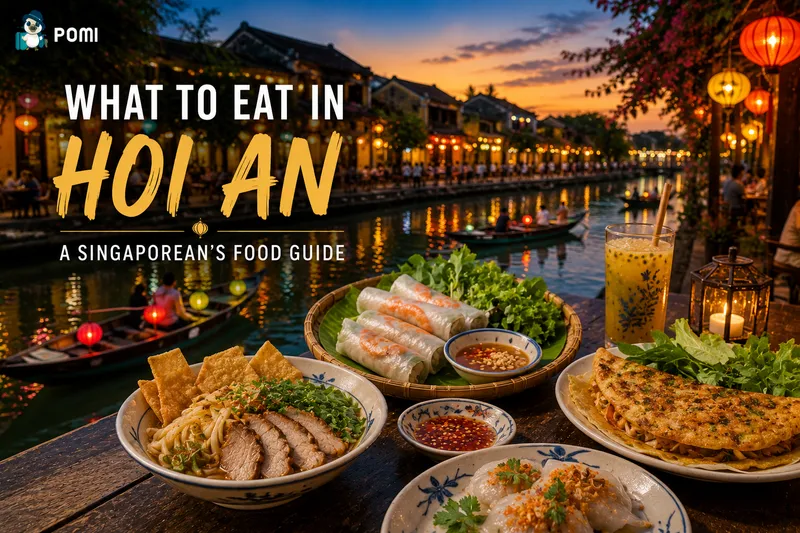
Cao lau is the dish most closely associated with Hoi An. It is a noodle dish with thick, chewy noodles made using water drawn specifically from a well in the Ancient Town, slow-braised pork, bean sprouts, and crispy rice crackers. The broth is thick and dark, closer to a sauce than a soup. Cao lau contains pork and is not halal.
White rose dumplings (banh bao vac) are delicate rice flour dumplings shaped like open flowers, steamed and served with a sweet and slightly spiced dipping sauce. They are light and subtle in flavour. They are typically made with shrimp, so they are not suitable for vegetarians, but they do not contain pork.
Banh mi Phuong is arguably the most famous banh mi in Vietnam. The shop run by Madam Phuong near the market has been serving the same recipe for decades: a crisp baguette loaded with pate, cold cuts, pickled vegetables, fresh chilli, and herbs. Anthony Bourdain ate here and called it the best banh mi he had eaten. The standard version contains pork. There is a chicken version available on request.
Com ga (Hoi An chicken rice) is rice cooked in chicken stock, served with shredded poached chicken, fresh herbs, and a light dipping sauce. It is the dish most comparable to something Singapore travellers will recognise. It is one of the easier options for those avoiding pork.
Where to Eat
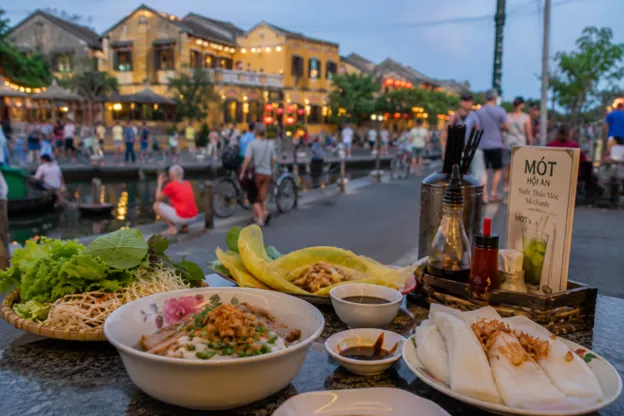
Riverside restaurants along Bach Dang Street and the Thu Bon riverfront are the most atmospheric option for dinner. Tables are set close to the water, lanterns reflect off the river, and the setting makes the meal feel like an event rather than just a refuelling stop. Prices are moderate to high by Vietnamese standards. Book ahead for Saturday evenings and around the Full Moon Lantern Festival.
Hoi An Central Market (Cho Hoi An) is the most practical place for a cheap, fast lunch. The upper floor of the market hall has a row of food stalls run by local women. You point at what you want, sit on a plastic stool, and eat for less than SGD 3 a dish. The selection covers banh mi, cao lau, white rose, noodle soups, and fresh spring rolls. It is loud, hot, and authentic.
Upscale dining has grown significantly in Hoi An over the past decade. Restaurants like the Morning Glory group (run by chef Trinh Diem Vy, who helped define Hoi An cuisine internationally) serve refined versions of local dishes in proper dining rooms. These are worth booking for one dinner if you want to eat well without going to a street stall. Prices are still reasonable by Singapore standards. Expect to pay SGD 20 to 40 per person for a full meal with drinks.
Street food stalls on Tran Cao Van Street and around the outer edges of the market area are the best hunting ground for cheap local eating outside the Ancient Town proper. Less touristy, more local, and cheaper than anywhere inside the old streets.
A Note on Pork
Most Hoi An dishes contain pork or pork-based products, including pork lard used in cooking. Cao lau, banh mi, and many soups use pork as a primary or background ingredient. If you are avoiding pork for dietary or religious reasons, you need to be specific when ordering, because asking for “no pork” alone is sometimes not enough if lard has already been used in preparation.
Halal-certified restaurants exist in Hoi An but are limited. Several establishments near Nguyen Truong To Street cater specifically to Muslim travellers and display halal certification. Your private guide can help identify these. Com ga (chicken rice) and fresh spring rolls with shrimp are generally safer choices at non-halal restaurants if cross-contamination is not a concern.
Cooking Classes
Hoi An is one of the best places in Vietnam to take a half-day cooking class, and several operators run them to a high standard. The typical format: morning market visit with your instructor to buy ingredients, then 2 to 3 hours in a riverside kitchen learning to make three or four local dishes. You eat what you cook for lunch.
Morning Glory Cooking School and Red Bridge Cooking School are the two most established operators. Red Bridge takes you by boat to a purpose-built kitchen outside town, which adds an outing feel to the experience. Both offer classes that can be tailored for dietary requirements if you book ahead.
A cooking class works well as an activity on a second day in Hoi An. If you are on a 5D4N itinerary, it fills a morning without feeling rushed. Budget SGD 40 to 70 per person depending on the operator and whether the market visit and boat transfer are included.
Morning Market Visits
The Hoi An morning market is at its best before 8am. Vendors arrive from the surrounding villages with fresh produce, live seafood, herbs, and flowers. Even if you are not cooking, it is worth walking through before breakfast. The colours and activity give you a sense of the town as a functioning community rather than just a heritage attraction.
If you are doing a cooking class, the market visit is usually part of the package. If not, it takes 20 to 30 minutes to walk through at a leisurely pace. The market is on Nguyen Hue Street, a short walk from the Ancient Town.
Food and Lanterns in the Evening
The most satisfying way to spend an evening in Hoi An is a combination of riverside dinner and a walk through the Ancient Town after dark. Have dinner at one of the riverfront restaurants from about 6pm, then walk into the old streets as the lanterns come on. If it is the 14th of the lunar month, the Full Moon Festival means even more atmosphere. Either way, any evening from 6pm onwards is worth the walk.
Buy a paper lantern from one of the stalls near the river, light it, and set it on the water. It is a tourist activity, but the sight of dozens of lanterns floating downstream is genuinely beautiful.
For the street food-focused side of Hoi An eating (specific stalls, night market snacks, and cheap eats), read our Best Street Food in Hoi An guide.
Plan Your Trip
Browse our private Vietnam tour packages from Singapore, priced in SGD with no hidden fees. Private guide, 3 to 4 star hotels, and meals included from SGD 448 per person. View Da Nang Tour Packages
Related Reads
- Best Street Food in Hoi An
- Hoi An Ancient Town: The Complete Guide for Singaporeans
- The Perfect Hoi An and Da Nang Itinerary from Singapore
- Da Nang vs Hoi An: Which Is Better for Singapore Families