Vietnam's markets can be overwhelming on a first trip. This guide helps Singapore travellers decide which food markets are worth visiting and how to eat well without stress.
Local markets are one of the fastest ways to understand how people eat in Vietnam. You see breakfast in motion, produce moving in bulk, and small cooked-food stalls serving regulars who know exactly what to order.
For Singapore travellers, market food can feel familiar because the energy sits somewhere between a wet market and a hawker centre. The difference is that every market works a bit differently, and not all of them are equally useful for eating.
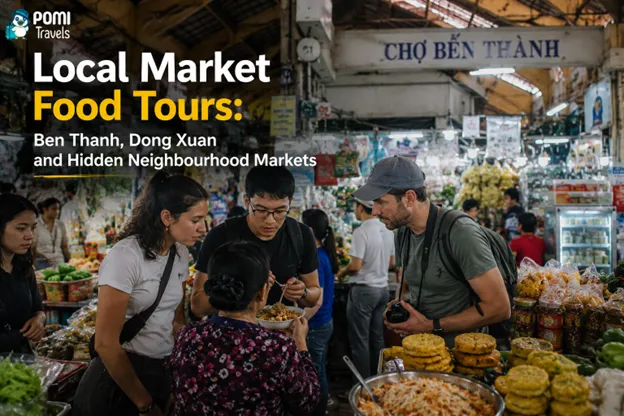
Ben Thanh Market: easy entry point in Ho Chi Minh City
Ben Thanh is the easiest market for first-time visitors. It sits in a central area, many drivers know it well, and the food side feels accessible even if you do not speak Vietnamese.
The trade-off is obvious. It is popular, busy, and more tourist-facing than a neighbourhood market.
That does not make it useless. It just means you should treat it as a convenient first stop, not the full picture of market eating in Vietnam.
What Ben Thanh is good for
- quick local dishes between sightseeing
- snacks and drinks in an easy central location
- a low-pressure introduction to Vietnamese market food
If your itinerary is short, Ben Thanh still makes sense.
Dong Xuan Market: better for a Hanoi atmosphere
Dong Xuan gives a rougher, more local market feel than Ben Thanh. It suits travellers who want a more everyday Hanoi setting and do not mind a less polished environment.
You may not use it as a long sit-down meal stop. The stronger value is in the atmosphere, the movement, and the chance to combine food with a wider look at local trade.
Pair it with a walk through the Old Quarter. That is when it works best.
Hidden neighbourhood markets: often the best food stops
The strongest market food experiences often happen outside the famous names. Smaller neighbourhood markets can feel less hectic, more local, and better for simple breakfast or lunch dishes.
You usually will not find these by searching for the most famous market on social media. You find them through local guides, hotel recommendations, or by noticing where residents actually stop to eat.
For Singapore travellers, this is often where the trip starts to feel less touristy.
What to eat at market food sections
Do not try to eat everything. Choose one noodle dish, one snack, and one drink first.
Good market choices often include:
- noodle soups
- rice dishes
- spring rolls
- grilled items
- fresh fruit
- local coffee
The exact dishes vary by city and time of day. The practical rule is to look for stalls with turnover and visible preparation.
Best times to go
Morning gives you the strongest market energy. You see regular shopping activity and many breakfast stalls operating at full speed.
Late afternoon can also work, especially for cooked food and snacks.
Midday is often the least comfortable time. It is hotter, and some sections feel slower.
How to choose where to eat
Watch what local customers are doing. If a stall has a simple menu, quick table turnover, and one or two dishes that everyone seems to order, that is usually a better sign than a stall trying to sell everything.
Cleanliness matters, but do not judge only by modern appearance. Some of the best market food comes from older stalls with basic setups and strong turnover.
If you feel unsure, start with cooked foods served hot rather than cold dishes.
Market tours versus going alone
A guided market food tour helps if this is your first Vietnam trip, if your time is short, or if your group has older parents who prefer a smoother experience. A guide removes the friction of finding the right stalls and explaining what is in each dish.
Going alone works if you enjoy exploring and can accept a few misses along the way.
Both approaches are fine. The better choice depends on how much effort you want to spend.
Tips for Singapore travellers
Bring small cash notes. Markets move faster when you do not hand over large bills for low-value snacks.
Wear light clothing. Markets can get warm and crowded.
Do not bring large shopping bags unless you are buying goods. They become annoying fast in tight lanes.
If you are travelling with children, choose one or two stalls with proper seating instead of trying to sample food while standing in busy walkways.
If anyone in your group has a sensitive stomach, avoid raw items and stick to food cooked fresh and served hot.
How markets fit into a Vietnam itinerary
Ben Thanh works well on a Ho Chi Minh City morning or afternoon around District 1 sightseeing.
Dong Xuan fits naturally into a Hanoi Old Quarter day.
Neighbourhood markets work best when your guide, hotel, or driver points you to one near where you are already staying or touring.
That is the simplest way to do it. Do not cross the whole city just to chase one market unless food is the main purpose of your day.
Final takeaway
Markets are worth visiting in Vietnam, but the smartest approach is not to chase only the biggest names. Use Ben Thanh for convenience, Dong Xuan for Hanoi atmosphere, and smaller neighbourhood markets for the meals that often feel most local.
Eat a few dishes well, go at the right time, and keep your plans practical. That is usually when market food becomes one of the most satisfying parts of the trip.
Plan Your Trip
Browse our private Vietnam tour packages from Singapore, priced in SGD with no hidden fees. Private guide, 3 to 4 star hotels, and meals included from SGD 448 per person.
Related Reads
- Vietnamese Cooking Classes and Food Experiences
- Vietnam Coffee Culture Guide
- Ho Chi Minh City Districts Explained
- Hanoi Old Quarter Walking Guide