Unlock the essentials of industry terminology in Vietnam tourism. Enhance your travel experience and navigate like a pro in Da Nang!
Vietnam tourism terms every Singaporean traveller must know

TL;DR:
- Vietnam’s tourism terminology is rooted in its legal and regulatory system, which impacts how hotels, guides, and transportation are classified and described. Understanding these official classifications and role definitions helps travelers set accurate expectations and avoid disappointment. Clear communication with operators by asking targeted questions about ratings, guide licenses, and service specifics ensures a smoother and more authentic experience on the ground.
You have just landed in Da Nang, your hotel booking confirms a “4-star deluxe” property, and your tour itinerary mentions a “step-on guide” for the Old Town visit. None of these terms were explained, and nobody warned you that they mean something quite specific under Vietnamese law and industry practice. For Singaporean travellers used to fairly standardised hotel grading and transparent tour descriptions, Vietnam’s tourism terminology can feel like a foreign language sitting on top of an already foreign language. This guide decodes the essential hospitality and guided-tour terms so you can book smarter, set the right expectations, and get far more out of every day on the ground.
Table of Contents
- Why does industry terminology matter in Vietnam tourism?
- Essential Vietnamese tourism terms every traveller should know
- Decoding accommodation classifications: Star ratings and legal standards
- Understanding tour guide and group terms: Who is leading your experience?
- Most tourists misunderstand Vietnam’s industry lingo—here is what actually happens on the ground
- Plan your Vietnam trip with experts who speak the language—literally and figuratively
- Frequently asked questions
Key Takeaways
| Point | Details |
|---|---|
| Check official ratings | Hotel stars in Vietnam are legally certified by specific authorities, not just for marketing. |
| Learn key Vietnamese terms | Knowing words like ‘sân bay’ and ‘khách sạn’ makes getting around simpler and builds confidence. |
| Clarify guide roles | Understand if your guide accompanies the full trip or just joins temporarily to match your expectations. |
| Ask about classification | For accurate bookings, always confirm hotel classification and guide style directly with providers. |
Why does industry terminology matter in Vietnam tourism?
Vietnam’s tourism sector operates within a distinct legal and regulatory framework. Unlike Singapore, where hotel classifications follow a broadly international model, Vietnam has its own statutory system for classifying accommodation, licensing tour operators, and defining the roles of guiding staff. When you book a tour or a hotel, the terminology used in the description is often drawn directly from these legal definitions. Misreading them, or accepting them at face value without context, can lead to real disappointment.
Consider a few practical scenarios:
- You book a “3-star” hotel based on a local listing, but you assume the standard matches a Singaporean or international 3-star property. In reality, the star rating may have been awarded by a provincial authority using criteria that differ from what you are used to.
- Your tour itinerary promises a “licensed guide” but does not explain whether that guide will be with you for the full trip or only for a single attraction.
- You encounter signage and front-desk staff using Vietnamese terminology that your booking platform never translated.
Each of these gaps traces back to the same root problem: a lack of clarity around industry-specific terms.
“In Vietnam’s accommodation sector, ‘tourist accommodation establishments’ are classified under the tourism legal framework; the competent assessing authority differs by star level — VNAT for 4- and 5-star; provincial tourism authorities for 1- to 3-star.”
What this means for you practically is that the same word, “star,” can represent two entirely different assessment processes depending on the tier of the property. This is not a flaw in the system; it is simply how the Vietnamese legal framework operates. But knowing it changes how you evaluate hotel claims.
It is also worth noting that transportation terminology in Vietnam follows a similarly layered structure, with terms like “limousine bus” and “open bus” carrying very specific meanings that differ from what you might expect elsewhere. Understanding this across both accommodation and transport gives you a genuinely clearer picture of what you are purchasing.
Now that you know why clarifying Vietnam’s tourism terminology is so important, let us decode the most common terms you will encounter on your trip.
Essential Vietnamese tourism terms every traveller should know
Even if you do not speak Vietnamese, recognising key words on signs, booking confirmations, and conversations with local staff gives you an immediate advantage. The most useful terms cluster around transport hubs, accommodation types, and service facilities.
Here is a practical reference table of the terms you are most likely to encounter:
| Vietnamese term | English meaning | Where you will see it |
|---|---|---|
| Sân bay | Airport | Transfer documents, taxi signs |
| Khách sạn | Hotel | Street signage, booking platforms |
| Ga | Station (train or bus) | Transit hubs, itineraries |
| Nhà hàng | Restaurant | Menus, tour inclusions |
| Bãi biển | Beach | Maps, resort descriptions |
| Chùa | Temple or pagoda | Spiritual site signage |
| Xe buýt | Bus | Public transport schedules |
| Phòng | Room | Hotel front desk interactions |
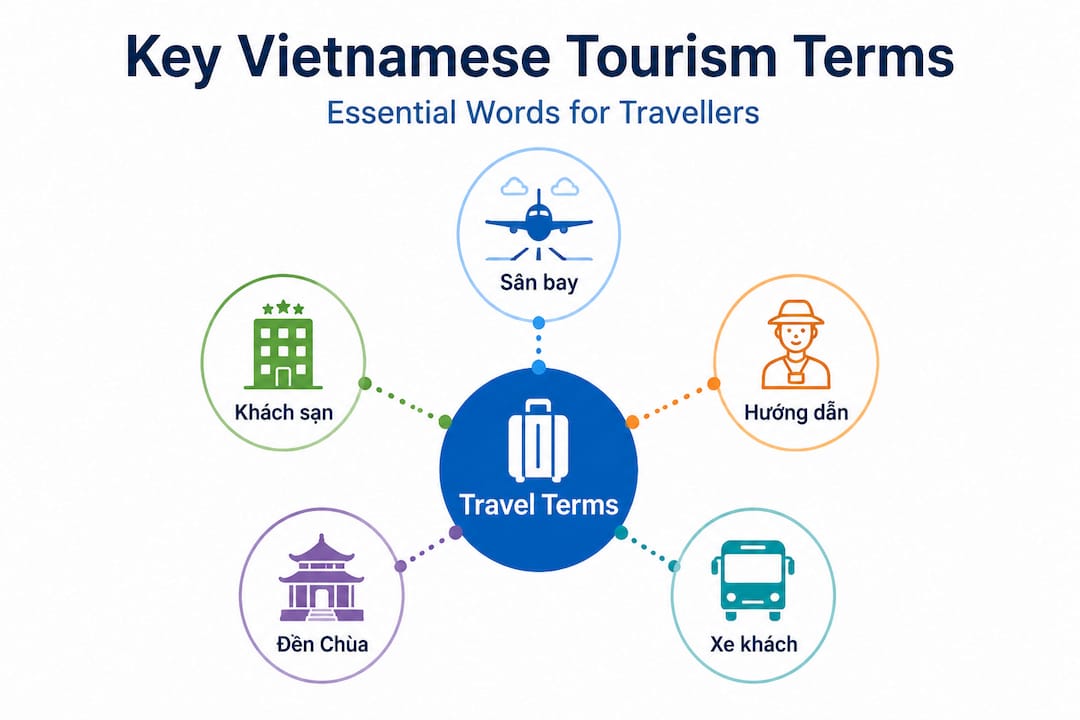
Beyond these core words, several terms appear specifically in tourism and guided-travel contexts. The word “hướng dẫn viên” refers to a licensed tour guide, and you may see it on official tour documentation or hear it when your operator introduces the guiding staff. “Điểm tham quan” means tourist attraction or sightseeing point, and it is frequently used in itinerary descriptions.
Vietnamese terms for travel sites, particularly spiritual and heritage locations, often include traditional words that have no direct English equivalent. Knowing the broad category (temple, pagoda, communal house) helps you interpret itinerary inclusions accurately.
For activity-related terminology such as kayaking, snorkelling, and boat excursions, local operators sometimes use a blend of Vietnamese and English terms, particularly in tourist-heavy destinations like Ha Long Bay and Hoi An. Asking for written confirmation of what is included avoids ambiguity.
Pro Tip: Save a screenshot of this table on your phone before departure. When communicating with local drivers, hotel staff, or market vendors, pointing to the written Vietnamese term is far more effective than attempting pronunciation, which can change meaning significantly in a tonal language.
Practical Vietnamese wording that overlaps with tourism experience terminology commonly includes “sân bay” for airport, “khách sạn” for hotel, and “ga” for station, all of which appear regularly in travel signage and documentation across Vietnam.
With this foundation, let us look at how Vietnam’s hospitality sector uses its own unique classifications and what those stars at a hotel really mean for your stay.
Decoding accommodation classifications: Star ratings and legal standards
This is where many Singaporean travellers get caught out. You see “4-star hotel” and your mind fills in the gaps with expectations built from stays in Singapore, Malaysia, or Thailand. But in Vietnam, the star rating on a hotel is a legal designation administered by a specific government authority, and that matters enormously.
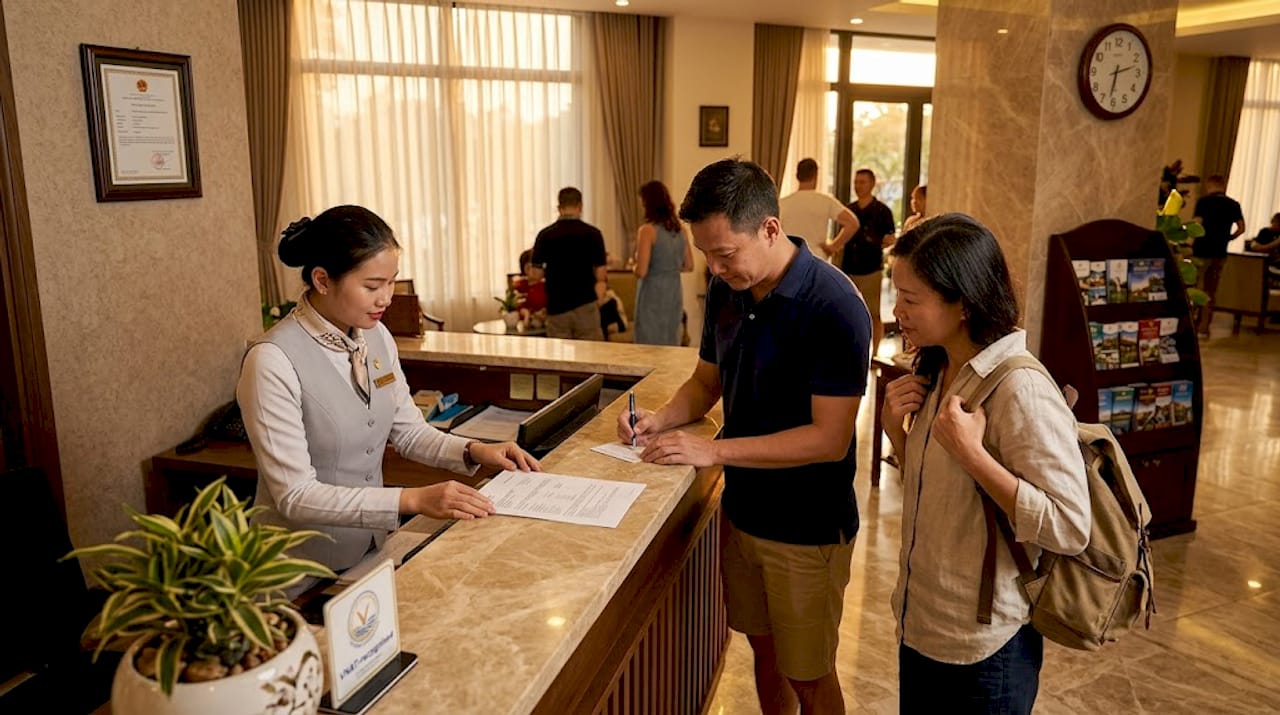
Here is how the tiered assessment system works:
| Star tier | Assessing authority | Validity period |
|---|---|---|
| 1, 2, and 3 star | Provincial tourism authority | 5 years |
| 4 and 5 star | Vietnam National Administration of Tourism (VNAT) | 5 years |
The star rating validity is legally recognised for five years before a property must seek renewal. This is a critical detail: a hotel awarded a 4-star rating five years ago may not have been reassessed since, meaning the current physical condition of the property could differ from what earned it that rating.
Here is a numbered checklist for evaluating hotel claims before you book:
- Check when the rating was awarded. A hotel approaching the end of its 5-year recognition period may not reflect current standards.
- Confirm who issued the rating. Properties assessed by VNAT (for 4 and 5 stars) generally undergo a more rigorous process than those rated by provincial bodies.
- Cross-reference with recent guest reviews. Legal ratings reflect compliance at the time of assessment; reviews reflect the current guest experience.
- Ask your tour operator directly. A reputable operator will confirm the official tier and be transparent about what is included in the room rate.
- Do not confuse “boutique” or “resort-style” with star ratings. These are marketing terms with no legal standing in Vietnam’s classification framework.
Pro Tip: When reviewing accommodation on your itinerary, look specifically for the words “VNAT-recognised” or “provincial-rated” if the operator provides that level of detail. If the documentation simply states “4-star,” ask for clarification. Reputable agencies will answer clearly and confidently.
Understanding accommodation booking steps for a private tour in Vietnam includes selecting accommodation that has been verified by your operator, which takes the guesswork out of the classification question. The Vietnam hospitality classifications used across our tour packages are transparently described so you know exactly what to expect on arrival.
International star rating systems, such as those used in Europe or Australia, are generally self-assessed or awarded by hospitality industry bodies. Vietnam’s system, being legally administered by government authorities, has a different character entirely. This is not better or worse; it is simply different, and knowing the difference means you will not be caught off guard.
Beyond accommodation, Vietnam’s guided travel scene relies on specialised terminology, especially around the roles of guides and the tour formats offered.
Understanding tour guide and group terms: Who is leading your experience?
The phrase “step-on guide” appears frequently in Vietnam tour itineraries, particularly for coach-based group tours and private vehicle experiences that cover multiple sites in a single day. If you have never encountered it before, you might assume it means a guide who joins the tour from the start. It does not.
“Roles like ‘step-on guide’ describe a specific operational pattern: a local guide joins the coach briefly to provide expertise, then departs. For travellers, this affects expectations around depth of narrative, language proficiency, and how consistently the same guide will accompany the full itinerary.”
In practice, this means the following:
- A step-on guide boards your vehicle at a specific attraction or area.
- They provide commentary and facilitation for that section of the itinerary.
- They leave when the group moves on to the next destination.
- A different guide, or no additional guide, may handle the next section.
This is a completely legitimate and common tour format in Vietnam. The issue arises when travellers assume a single guide will accompany them throughout the entire journey, providing consistent narration and a building relationship with the group. If depth and continuity matter to you, ask your operator specifically whether the guide is a full-journey guide or a step-on guide at particular sites.
Other guiding roles you may encounter include:
- Tour leader or tour manager. This person handles logistics, group coordination, and problem-solving for the full duration of the trip. They are not always a specialist in local history or culture.
- Local specialist guide. A licensed guide based in a specific city or region, often employed to cover a defined area rather than the entire tour.
- Driver-guide. Common on private tours, this person drives and provides narration, though their depth of knowledge varies considerably.
Understanding how guiding roles are structured before you book a private tour helps you ask the right questions and avoid expecting one person to perform multiple distinct roles. You can also find useful tour guide role comparisons to see how Vietnam’s approach compares to other destinations in the region.
Having demystified the core terminology, here is a summary of what actually matters when you put these industry terms into practice as a Singaporean traveller.
Most tourists misunderstand Vietnam’s industry lingo—here is what actually happens on the ground
We have seen this pattern repeatedly: well-prepared Singaporean travellers, people who have researched their itinerary thoroughly and read plenty of travel forums, still arrive with misaligned expectations because the terminology they relied on was never properly defined.

Brochure language is optimistic by nature. A “5-star resort experience” can legally refer to a property that earned its VNAT rating several years ago and has not been reassessed. A “professional guide” may mean a fully licensed hướng dẫn viên who has passed national licensing exams, or it may mean a locally hired assistant who speaks reasonable English. Both descriptions appear in tour materials, and both are technically accurate in different ways.
The most seasoned Vietnam travellers we work with share a common habit: they ask specific, direct questions before confirming any booking. Not “is the guide experienced?” but “is the guide nationally licensed, and will the same guide accompany us for the full itinerary?” Not “is the hotel good?” but “when was the star rating last assessed, and which authority issued it?”
Real-world transport terminology in Vietnam is another area where on-the-ground reality diverges from brochure descriptions. A “private transfer” in Vietnam typically means a vehicle dedicated to your group, but the class of vehicle, the condition of the air conditioning, and whether the driver speaks English are all variables that require separate confirmation.
Our honest advice is this: treat Vietnam tourism terminology as a starting point for your questions, not the final answer. Each term is a doorway into a more detailed conversation with your operator. The agencies that handle this well are the ones worth booking with.
Plan your Vietnam trip with experts who speak the language—literally and figuratively
Navigating Vietnam’s tourism terminology is far less stressful when the agency you book with takes that responsibility seriously from the start.
At Vietnam Tour Package, every itinerary is built with transparency at its core. We clearly describe accommodation tiers, guiding roles, and transport arrangements using plain language alongside the official terminology, so you always know what you are getting. Our packages are designed specifically for Singaporean travellers, which means we understand the expectations you bring and the gaps that Vietnamese industry terms can create. Whether you are exploring the streets of Ho Chi Minh City on a 4-day Ho Chi Minh City tour or taking in the cultural depth of the central region on a Da Nang and Hoi An tour, our team handles the terminology so you can focus on the experience. Browse all available Vietnam tour packages and reach us directly via WhatsApp to get answers to any terminology questions before you commit.
Frequently asked questions
Who sets official hotel star ratings in Vietnam?
The Vietnam National Administration of Tourism assesses and recognises 4- and 5-star accommodations, while provincial tourism authorities handle 1-, 2-, and 3-star properties.
What does “step-on guide” mean in Vietnam tour descriptions?
A step-on guide joins your group at a specific attraction or location and departs once that section is finished, so they will not accompany you for the entire itinerary.
How long is a hotel’s star rating valid in Vietnam?
Star ratings are legally recognised for five years before the property must go through the renewal process with the relevant authority.
What are the most useful Vietnamese words for travel?
“Sân bay” means airport, “khách sạn” means hotel, and “ga” means station, making these three terms the most immediately practical for navigating arrival, accommodation, and transit across Vietnam.
Recommended
- Vietnam Visa Requirements for Singapore Citizens 2026 | VietnamTourPackage.sg
- Tipping Culture in Vietnam | VietnamTourPackage.sg
- Vietnam Tour Packages from $428 SGD
- War Remnants Museum Guide | VietnamTourPackage.sg