Discover what is Vietnam visa on arrival! Learn the process, requirements, and tips to avoid pitfalls for a smooth travel experience.
Vietnam visa on arrival: what you need to know
TL;DR:
- You cannot get a Vietnam visa on arrival without prior approval, which is obtained through a licensed agency.
- In 2026, VOA is mainly limited to organized tour groups, while independent travelers should use the e-visa system for easier entry.
Planning a trip to Vietnam and wondering whether you can simply turn up at the airport and collect your visa? You cannot. Understanding what is Vietnam visa on arrival, and precisely how it works, will save you from a very expensive lesson at the check-in counter. This article covers the full Vietnam visa on arrival process for 2026, including who qualifies, what documents you need, common pitfalls to avoid, and how it compares to the Vietnam e-visa, so you can make the right call before you book your flights.
Table of Contents
- Key takeaways
- What is Vietnam visa on arrival?
- Who can use visa on arrival in 2026?
- Common mistakes that cause real problems
- VOA versus e-visa: which should you choose?
- Practical guide: preparing for visa on arrival
- My honest take on visa on arrival in 2026
- Plan your Vietnam trip with confidence
- FAQ
Key takeaways
| Point | Details |
|---|---|
| Pre-approval is mandatory | You must obtain an approval letter from a licensed agency before travelling; airlines will not let you board without it. |
| VOA is not for everyone in 2026 | Visa on arrival is now mainly restricted to travellers on organised air tours; most independent travellers should use an e-visa instead. |
| Cash stamping fee required | You must bring USD in cash to pay the stamping fee at the airport counter: $25 for single-entry, $50 for multiple-entry. |
| Data accuracy is critical | Even a minor typo in your approval letter, such as a missing middle name, can result in denied boarding or fines at immigration. |
| Digital Arrival Card is separate | The mandatory Digital Arrival Card (DAC) must be completed within 72 hours before arrival and is distinct from your visa. |
What is Vietnam visa on arrival?
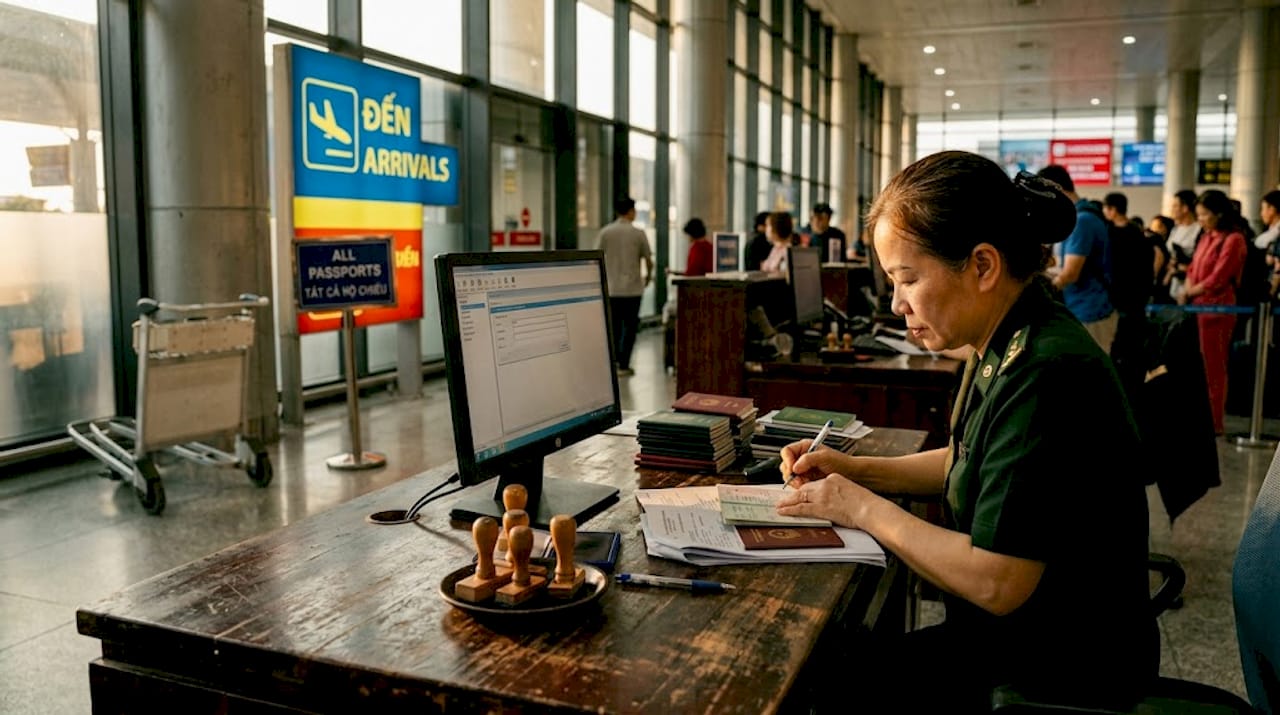
Despite its name, a Vietnam visa on arrival is not something you arrange on the day. VOA is not spontaneous; it requires a pre-approved visa letter obtained through a licensed agency before you even reach the airport. Without it, the airline will deny you boarding. Once you have that letter, you present it at a dedicated VOA counter upon arriving at certain international airports in Vietnam, pay the stamping fee, and receive your visa sticker. That is the visa on arrival Vietnam workflow in full.
How the step-by-step process works
Here is a numbered breakdown of the complete Vietnam visa on arrival process:
- Apply online through a licensed visa agency. Submit your passport details, travel dates, entry type (single or multiple), and pay the service fee. This is the stage where accuracy matters most.
- Receive your approval letter by email. This typically takes one to three business days for standard processing, though some agencies offer expedited options.
- Print the approval letter. Airlines will ask to see it during check-in. A digital copy on your phone is generally not sufficient. Print two copies to be safe.
- Complete the NA1 entry and exit form. Download this from the visa agency or airline website and fill it in before you land.
- Prepare two passport-sized photos (4 x 6 cm) and bring USD cash for the stamping fee.
- At the airport, proceed to the VOA counter. Submit your passport, approval letter, completed NA1 form, photos, and stamping fee.
- Wait for processing. Airport counter processing typically takes 15 to 30 minutes depending on queue length and time of arrival.
- Receive your visa sticker. Check every detail against your passport before you leave the counter.
VOA counters are available at four major international airports: Noi Bai (Hanoi), Tan Son Nhat (Ho Chi Minh City), Da Nang International, and Cam Ranh (Nha Trang). No land borders or seaports accept VOA.
Pro Tip: Arrive on a morning flight if possible. VOA counters tend to be far less congested in the morning than during evening peak arrivals, which can reduce your wait from 30 minutes to under 10.
Who can use visa on arrival in 2026?
This is where many travellers get caught out. VOA is now restricted mainly to travellers arriving as part of organised air tours. If you are travelling independently, the Vietnamese government strongly steers you towards the e-visa system, and at most entry points, VOA is no longer accepted at all for independent visitors.
Your passport must also be valid for at least six months beyond your intended arrival date. Vietnamese immigration officials enforce this strictly, and insufficient validity means denied entry regardless of which visa type you hold.

Here is how the two options compare side by side for 2026 travellers:
| Feature | Visa on arrival (VOA) | Vietnam e-visa |
|---|---|---|
| Application method | Online via licensed agency, pre-approval letter printed | Fully online, visa issued digitally |
| Eligibility | Mainly organised air tour passengers | Most nationalities, independent travellers |
| Entry points accepted | 4 international airports only | 42 checkpoints including land and sea |
| Processing time | 1 to 3 days for letter; 15 to 30 min at airport | 3 to 7 business days online |
| Fees | Agency fee plus $25/$50 USD stamping fee | Government fee, no additional stamping fee |
| Airport counter required | Yes | No |
| Maximum stay | Up to 90 days (tour-dependent) | Up to 90 days |
For most Singaporean travellers checking Vietnam visa requirements, the e-visa is now the cleaner, faster choice. VOA retains genuine value primarily for travellers on structured group tours where the tour operator manages the approval letter process.

Common mistakes that cause real problems
The single most costly mistake travellers make is data inaccuracy. Minor typos or omissions on the approval letter, such as a missing middle name or an incorrect date of birth, routinely result in denied boarding or fines at Vietnamese immigration. The responsibility for accuracy sits entirely with the traveller, not the agency.
Beyond data errors, here are the mistakes that catch people out most often:
- Forgetting to print the approval letter. Airlines will not accept a screenshot. Carry printed copies.
- Not having USD cash. The stamping fee is cash only, in USD: $25 for single-entry and $50 for multiple-entry visas. Cards are not accepted at VOA counters.
- Confusing the Digital Arrival Card with the visa. Since April 2026, travellers must complete the DAC within 72 hours before arrival at major airports. It collects immigration and health data and is entirely separate from your visa approval.
- Using an unlicensed agency. Rogue operators exist. If the approval letter contains errors or is fraudulent, you have no recourse at the airport.
- Not checking the visa stamp before leaving the counter. Once you walk away, any error becomes your problem to fix, which may involve leaving the country and re-entering.
“Travellers must verify every detail of visa documents against their passport — many overlook this step until arrival problems arise.” Smartraveller
Pro Tip: When your approval letter arrives by email, open it immediately and read every character against your passport. Check spelling, date of birth, passport number, and nationality. Request a correction before your trip, not at the airport.
VOA versus e-visa: which should you choose?
The honest answer for most travellers reading this in 2026 is: use the e-visa. The VOA system is being phased out in favour of fully digital processes to improve border security and reduce congestion. For independent travellers, the e-visa is accepted at 42 entry checkpoints, is processed fully online, and does not require queuing at an airport counter after a long flight.
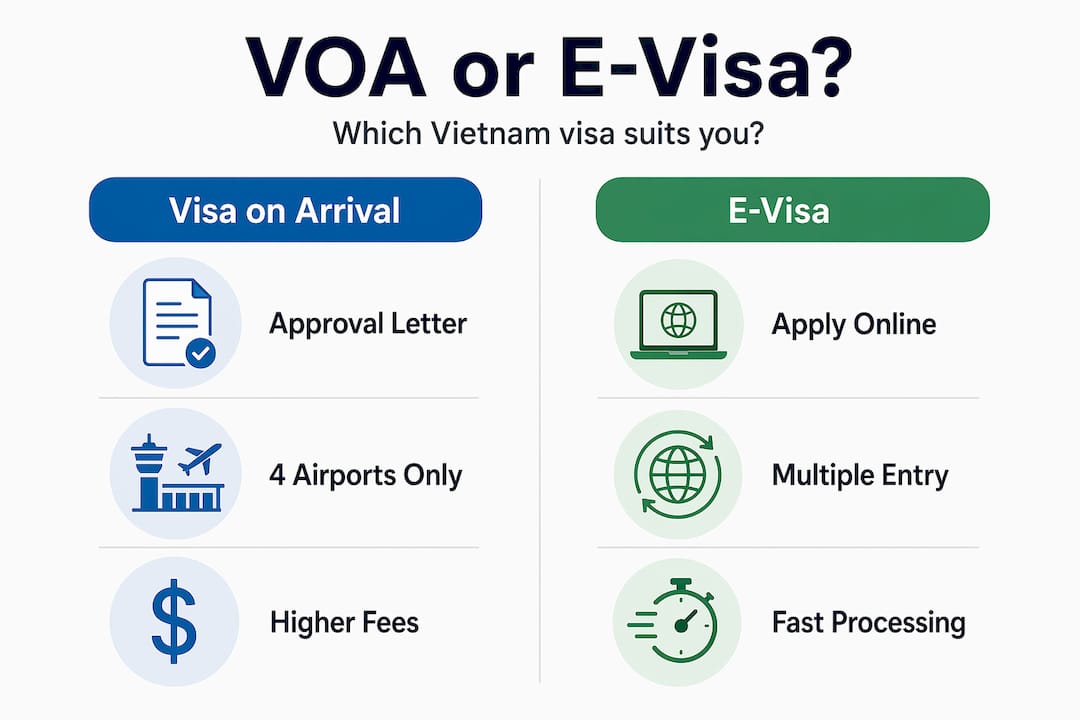
VOA still makes sense in specific circumstances. If you are travelling on an organised group tour and the tour operator handles the approval letter process, the extra airport steps are manageable. It may also suit travellers who need a visa quickly and find the e-visa processing window too tight, though expedited e-visa services exist for exactly this scenario.
The deeper point is that the Vietnam visa process has genuinely improved. The e-visa system is reliable, widely accepted, and removes the logistical friction of printing documents, sourcing USD cash, and waiting at counters after arrival. If you are planning a trip and wondering how to get a Vietnam visa with the least hassle, start with the e-visa application and only consider VOA if your specific travel circumstances require it.
Practical guide: preparing for visa on arrival
If you have confirmed you qualify for VOA and need to proceed, follow this preparation checklist to avoid the most common problems.
- Select a licensed agency. Look for agencies with verifiable track records, clear fee structures, and contact details. Avoid those with no reviews or suspiciously low fees.
- Submit accurate details. Match every field exactly to your passport, including middle names, spelling variations, and passport expiry date.
- Print two copies of the approval letter and the NA1 form. Keep one set accessible in your carry-on.
- Prepare two 4 x 6 cm passport photos and separate USD cash for the stamping fee.
- Complete the Digital Arrival Card within 72 hours before your flight. Do this from home, not in the queue at the airport.
- At the VOA counter, submit your passport, printed approval letter, NA1 form, photos, and cash fee together. Keep calm and check the queue signs carefully. Counters are separate from general immigration.
- Inspect your visa sticker before stepping away. Confirm your name, passport number, entry type, and visa validity dates all match your travel plan.
- If you spot an error, raise it immediately with the immigration officer at the counter before proceeding further into the airport.
For travellers coming from Singapore, you can find a detailed breakdown of entry rules and documentation to help with the full planning process.
My honest take on visa on arrival in 2026
I have spoken with a lot of travellers who return from Vietnam frustrated, not because of anything that happened in the country itself, but because the visa process caused unnecessary stress before they even boarded. In almost every case, the problem was either a data error or a fundamental misunderstanding of how VOA works.
What strikes me most is how often people treat VOA as a convenience when it is actually the more logistically demanding option. You need to source USD cash in the right denominations. You need to print physical documents. You queue after an already long journey. And you carry the full risk of any error made weeks earlier by yourself or the agency.
The e-visa removes most of that friction entirely. I would recommend it to any independent traveller without hesitation. The only scenario where I see VOA making genuine sense today is within an organised tour where the operator manages the paperwork and the group queues together.
The VOA system served its purpose well for years, but it is being replaced for good reasons. Travellers who plan ahead, choose e-visas where eligible, and double-check every document will have a far smoother arrival experience in Vietnam. The ones who do not tend to find out the hard way that the airport is not the place to solve document problems.
— Kuan
Plan your Vietnam trip with confidence
Understanding the Vietnam visa process is the first step towards a trip that actually goes to plan. At Vietnamtourpackage, we work with Singaporean travellers every day who want the simplicity of having visa logistics, transfers, accommodation, and guided experiences handled by people who know Vietnam well. Our organised Vietnam tour packages from $428 SGD are structured specifically so that the entry process is managed as part of your booking, reducing the paperwork burden on you. Whether you are considering a Ho Chi Minh City long weekend or a broader multi-city itinerary, our team can advise on the right visa option for your travel profile and handle the details that most travellers find stressful. Get in touch via WhatsApp to start planning.
FAQ
What is a Vietnam visa on arrival exactly?
Vietnam visa on arrival is a pre-arranged visa process where you obtain an approval letter from a licensed agency before travelling, then collect your visa sticker at a designated counter at select Vietnamese international airports.
Can I get a Vietnam visa on arrival without prior application?
No. Airlines will deny boarding without the pre-approved letter. You cannot obtain VOA spontaneously at the airport without arranging it in advance.
Is Vietnam visa on arrival safe to use?
VOA is safe when processed through a verified, licensed agency. The risk comes from unlicensed operators or data inaccuracies in the approval letter, both of which can lead to denied boarding or entry problems.
How much does the Vietnam visa on arrival stamping fee cost?
The stamping fee is $25 USD for single-entry and $50 USD for multiple-entry visas, payable in cash at the airport counter.
What is the Digital Arrival Card and is it part of the visa?
The Digital Arrival Card is a separate mandatory pre-arrival requirement introduced at major Vietnamese airports since April 2026. It must be completed within 72 hours before arrival and is not part of the visa application itself.
Recommended
- Vietnam Visa Requirements for Singapore Citizens 2026 | VietnamTourPackage.sg
- Private tour booking steps for a seamless Vietnam trip | VietnamTourPackage.sg
- Tipping Culture in Vietnam | VietnamTourPackage.sg
- Vietnam Travel Blog | VietnamTourPackage.sg